AI
RAG on Postgres You Already Have: pgvector From Scratch
You don't need a dedicated vector database to ship retrieval-augmented generation. With the pgvector extension, the Postgres instance behind your app becomes a semantic search engine. Here's the whole pipeline — chunking, embedding, storing, and querying.
Article · RAG
RAG on Postgres You Already Have: pgvector From Scratch
On this page
RAG on Postgres You Already Have
Retrieval-augmented generation (RAG) sounds heavier than it is. Strip away the acronym and it's one idea: before you ask the model a question, find the most relevant pieces of your own data and paste them into the prompt. The model answers from that context instead of from memory, so it can cite your docs and stop hallucinating facts it was never given.
The part people over-engineer is storage. You'll read that you need a specialized vector database. For most projects you don't — if you already run Postgres, the pgvector extension turns it into a perfectly good vector store. One fewer service to run, back up, and pay for.
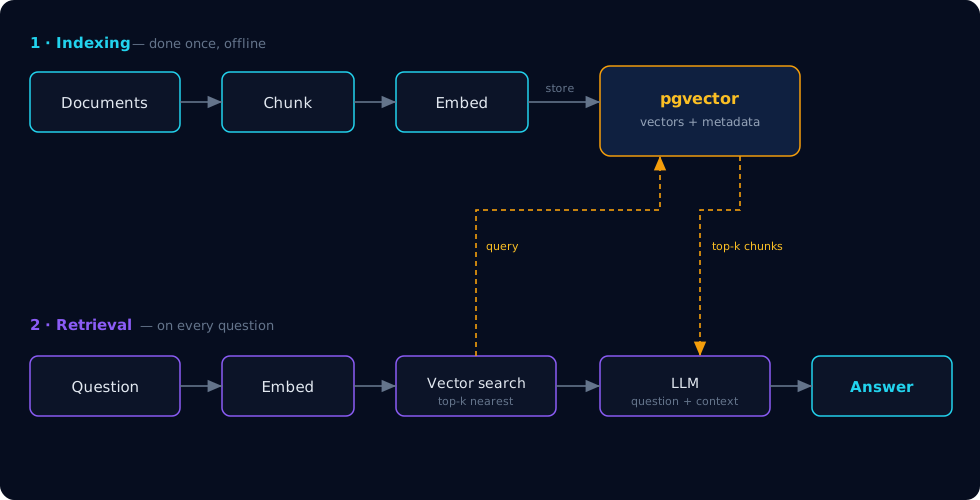
Here's the shape of the whole thing:
Step 1: Turn on pgvector
It ships with most managed Postgres providers now. Enable the extension and add a column to hold embeddings:
CREATE EXTENSION IF NOT EXISTS vector;

CREATE TABLE chunks (
  id        bigserial PRIMARY KEY,
  document  text NOT NULL,
  content   text NOT NULL,
  embedding vector(1536)
);
The 1536 is the dimension of the embedding model you'll use — it must match exactly. Swap models later and you re-embed everything, so pick one and note it somewhere.
Step 2: Chunk, don't dump
Embedding an entire document as one vector throws away everything that makes retrieval useful — you get back a whole file when you wanted one paragraph. Split first. A simple, surprisingly effective rule: split on headings and paragraphs, then merge fragments up to ~500 tokens, keeping a little overlap so a sentence that straddles a boundary isn't orphaned.
function chunk(text: string, target = 500, overlap = 60): string[] {
  const paragraphs = text.split(/\n\s*\n/);
  const chunks: string[] = [];
  let buffer = "";

  for (const p of paragraphs) {
    if ((buffer + p).length > target * 4) {
      chunks.push(buffer.trim());
      buffer = buffer.slice(-overlap * 4);
    }
    buffer += "\n\n" + p;
  }
  if (buffer.trim()) chunks.push(buffer.trim());
  return chunks;
}
(The * 4 is a rough chars-per-token approximation — good enough for chunking; use a real tokenizer if you need precision.)
Step 3: Embed and store
Each chunk goes to an embedding model, and the resulting vector lands in Postgres. pgvector accepts the vector as a bracketed string literal:
async function indexDocument(document: string, text: string) {
  for (const content of chunk(text)) {
    const embedding = await embed(content); // → number[]
    await sql`
      INSERT INTO chunks (document, content, embedding)
      VALUES (${document}, ${content}, ${JSON.stringify(embedding)})
    `;
  }
}
Once you have more than a few thousand rows, add an approximate index so search stays fast. HNSW gives the best recall/speed trade-off:
CREATE INDEX ON chunks
USING hnsw (embedding vector_cosine_ops);
Step 4: Retrieve
At query time you embed the question the same way, then ask Postgres for the nearest chunks. The <=> operator is cosine distance (smaller = more similar):
async function retrieve(question: string, k = 5) {
  const q = await embed(question);
  return sql`
    SELECT content, 1 - (embedding <=> ${JSON.stringify(q)}) AS score
    FROM chunks
    ORDER BY embedding <=> ${JSON.stringify(q)}
    LIMIT ${k}
  `;
}
1 - distance converts distance into a 0–1 similarity score, which is handy for filtering: below ~0.7 usually means "nothing in the corpus actually answers this," and you're better off saying so than stuffing weak context into the prompt.
Step 5: Answer with context
Finally, assemble the retrieved chunks into a prompt and let the model write the answer:
const context = (await retrieve(question))
  .map((r) => r.content)
  .join("\n\n---\n\n");

const prompt = `Answer using ONLY the context below. If the answer isn't
there, say you don't know.

Context:
${context}

Question: ${question}`;
That instruction — use only the context, and admit when it's missing — is doing real work. It's the difference between a system that grounds its answers and one that quietly falls back to guessing.
Takeaways
- RAG is "retrieve, then prompt." The magic is in the retrieval, not the model.
- pgvector makes your existing Postgres a vector store — no separate database for most workloads.
- Chunk on structure with overlap. Whole-document embeddings retrieve poorly.
- Add an HNSW index once the table grows, and use the similarity score to detect out-of-corpus questions.
- Tell the model to answer only from context and to say "I don't know" — grounding is a prompt instruction, not just a data-flow.
Start on the database you already have. Reach for a dedicated vector store when you can prove Postgres is the bottleneck — not before.